
No products in the cart.


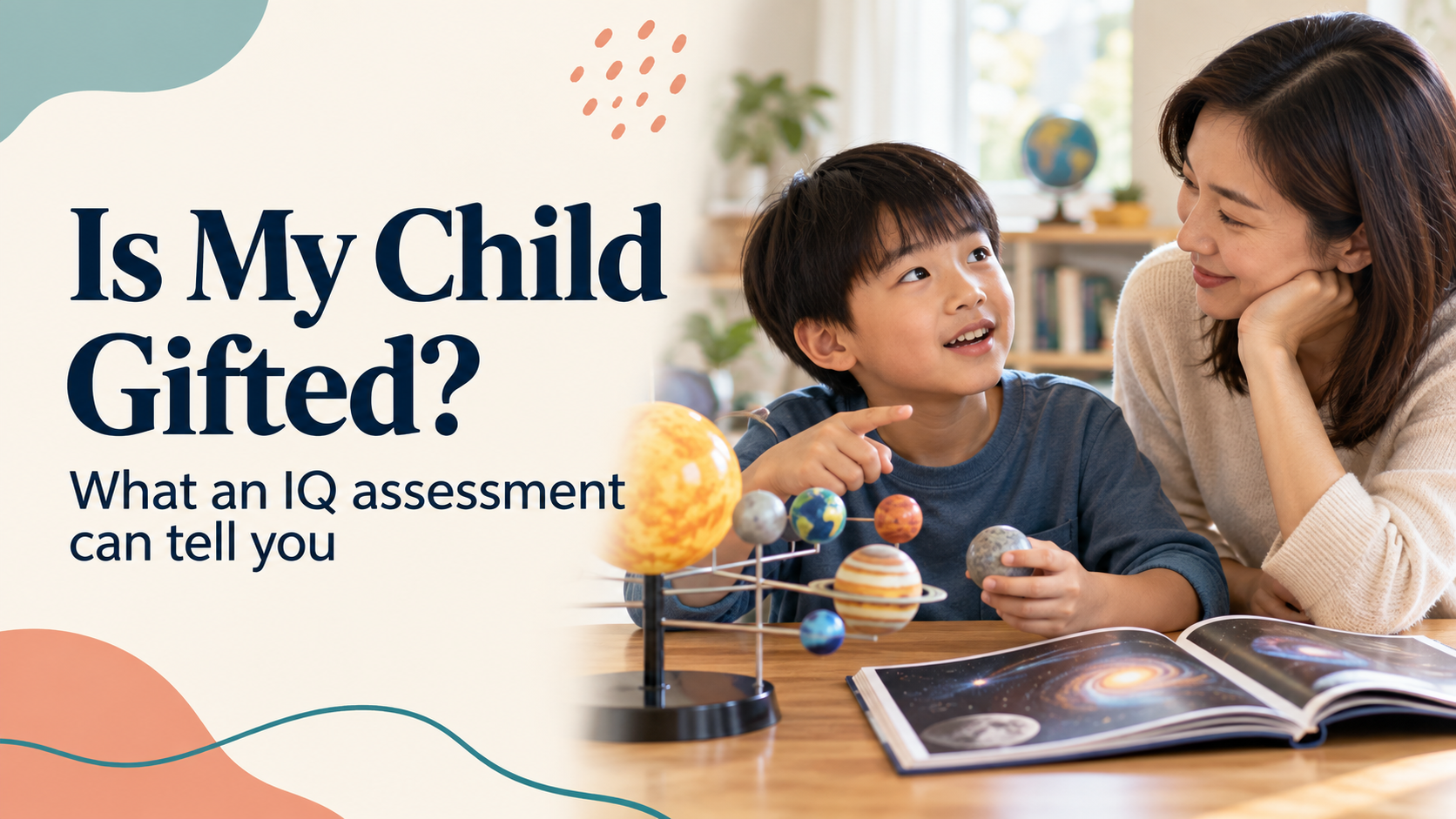
She was reading at three. He asks about black holes at dinner. Or your child is clearly bright, yet bored and underachieving at school. Many parents wonder: is my child gifted?
An IQ assessment can help answer that — but not every question.
An IQ assessment is a set of puzzles, questions and pattern tasks done one-to-one with a psychologist. Most children find it a lot like playing games. It takes about two hours.
There’s no single official cut-off for “gifted”, but many use a score of 130 or above — roughly the top 2% of children the same age.
Large vocabulary or early reading, endless “why” questions, learning quickly with little repetition, deep interest in favourite topics, and frustration with work that’s too easy. Some gifted children are quiet and easy to miss. Others are disruptive because they’re bored.
An assessment is most useful when your child is bright but struggling, bored or refusing schoolwork, or when you suspect a learning difference. It’s less useful if the only goal is a number to compare.
Scores become more stable from about age six. And please don’t practise IQ-type puzzles beforehand — it makes the results inaccurate.
Note that school programmes for high-ability learners in Singapore use their own selection process. A private assessment doesn’t replace it, but it can guide conversations with teachers.
CHEERS psychologists conduct cognitive assessments with a clear report and discussion session. Not sure whether testing is right for your child? Book a consultation or WhatsApp us, and we’ll talk it through first.
Cheers Learning
Hi there 👋 How can we help
Cheers Learning